"Chat with any YouTube video" sounds like magic. In practice, a lot of tools ship something closer to "paste a URL into a general chatbot and hope."
That hope is the problem. Large language models are excellent at sounding sure. They are much less excellent at staying tied to this video at this timestamp — unless the product is designed to force that constraint.
This guide explains what grounded AI video chat actually is, how it differs from ungrounded chat, where ChatGPT URL paste and YouTube's own Ask features fit, why citations matter, and where transcript-only tools honestly fall short.
Disclosure: this post is published by Summario, an AI YouTube summarizer with grounded chat. We mention other tools by name for context; we do not send you to their sites.
What People Mean by "AI Chat With a YouTube Video"
At the surface, the promise is simple: open a video, ask a question in plain language, get an answer about that video.
Under the hood, products usually land in one of three buckets:
- Ungrounded general chat — The model answers from training knowledge about the topic, or from a vague web fetch, while the UI implies it "watched" your link.
- Transcript-paste chat — Someone (you or a plugin) feeds captions into a model. Better, but still easy to lose grounding on long videos, and citations are often missing.
- Grounded, cited video chat — The system retrieves from the video's actual text, answers from that evidence, and shows where each claim came from — ideally as clickable timestamps.
Only the third version consistently turns AI chat into a trustworthy workflow instead of a persuasive essay about the subject matter.
Grounded vs Ungrounded Video Chat
Ungrounded means the model can invent details that feel related to the video without being able to prove them from the source. Ask "What did she say about pricing at the end?" and you might get a clean three-bullet answer that never happened in the recording.
Grounded means the answer is constrained to retrieved evidence from the video (almost always the transcript or captions). If the evidence is missing, a well-built system says so instead of filling the gap.
This distinction is not marketing fluff. In long-form generation research, models still produce a meaningful share of ungrounded sentences even when retrieval is available — including cases where the overall answer looks correct. An empirical study of retrieval-augmented long-form generation found that a significant fraction of generated sentences remain ungrounded across datasets and model families (Gao et al., arXiv:2404.07060). Separate work on citation quality shows that even strong systems often fail to fully support claims with citations; on one long-form dataset, the best setups still lacked complete citation support roughly half the time (Gao et al., ALCE / arXiv:2305.14627).
So "we retrieved the transcript" is necessary but not sufficient. Grounding needs retrieval and answer discipline and a verification path for the human.
A quick litmus test
Ask the same tool three questions:
- Something specific that appears once, late in the video ("What caveat did they give after the demo?")
- Something the video never covers ("What is their Series B valuation?")
- Something visual-only if you know one exists ("What number is on the slide at 8:10?")
A grounded tool should nail the first, refuse or clearly hedge the second, and either admit transcript limits on the third or use true multimodal analysis. An ungrounded tool often answers all three with the same confident tone.
How ChatGPT URL Paste Usually Works (And Where It Breaks)
People try ChatGPT first because they already pay for it. The typical flows:
Paste the URL and ask for a summary. This does not reliably mean ChatGPT watched the video. Unless a browsing/plugin path actually fetches captions, you may get topic-level guesswork rather than video-level evidence. OpenAI's models are general assistants; video watching is not their default job.
Copy the transcript yourself. This is the honest manual method. Open YouTube → Show transcript → paste into ChatGPT → ask questions. It works for short, clean talking-head videos. Limits show up fast:
- Long podcasts blow past comfortable context or get summarized into mushy middle sections.
- You lose clickable timestamps unless you carefully preserve and prompt for them.
- Visual information never enters the chat.
- Messy auto-captions increase hallucination pressure — the model "helps" by smoothing gaps.
Plugins / custom GPTs / browser helpers. These remove copy-paste friction by fetching captions for you. Useful. They do not automatically solve grounding or citation quality. Many still return paragraph answers with no jump-to-moment links.
For a deeper walkthrough of the ChatGPT path, see Can ChatGPT summarize YouTube videos? and our prompt guide.
Dedicated YouTube AI Chat Tools
Purpose-built tools (Chrome extensions and web apps) exist because the URL-paste loop is tedious and fragile if you do this daily.
What a dedicated product should do well:
- Fetch or generate transcript text without manual pasting
- Answer follow-ups about this video
- Attach timestamp citations you can click
- Handle long-form content without quietly forgetting the first half
- Prefer "I don't see that in the transcript" over a plausible guess
Summario is built around that last point. Its YouTube AI chat is grounded in the video's content and returns cited timestamps so you can verify before you trust. Around the chat layer you also get Watch/Skip verdicts (should you spend 40 minutes on this at all?), structured summaries, and optional email/WhatsApp digests if you follow many channels. Free tier available; Pro is about $5.75/mo on annual billing.
Competitors like Eightify focus more on key-insight summaries than deep cited chat. That is fine if you only need bullets. If your workflow is "ask three precise questions, then jump to the receipts," chat-with-citations is the feature that matters.
Where Ask YouTube Fits
YouTube has been rolling out conversational AI under the Ask YouTube umbrella. There are related experiences to keep straight:
Ask YouTube search synthesizes answers from YouTube content (and related web context), with text plus video clips that can jump to relevant moments. YouTube documents this as a conversational search mode complementary to classic keyword search (YouTube Help: Search with Ask YouTube). Coverage has expanded over 2026 for signed-in users in supported regions and languages; availability still varies by account, device, and rollout.
Ask YouTube on the watch page lets you interact with AI while viewing a video — questions about the content, related recommendations, and similar helpers (YouTube Help: Ask YouTube on the watch page). YouTube is explicit that responses are generated by LLMs, quality can vary, and answers may draw on YouTube and the web — not a guarantee of pure single-video transcript grounding.
How to think about it practically:
| Need | Better fit |
|---|---|
| Explore a topic across many videos | Ask YouTube search |
| Stay inside YouTube with zero install | Ask on watch page / native AI |
| One video, cited Q&A, Watch/Skip triage, digests | Dedicated tool (e.g. Summario) |
| Occasional one-off with a transcript you already have | ChatGPT paste |
Native YouTube AI is convenient. Dedicated tools win on workflow features YouTube does not try to own — verdicts, WhatsApp digests, exportable research notes, and a product posture that treats citation as the default UI, not an optional flourish.
Why Timestamp Citations Matter
Accuracy is the obvious reason. Workflow is the bigger one.
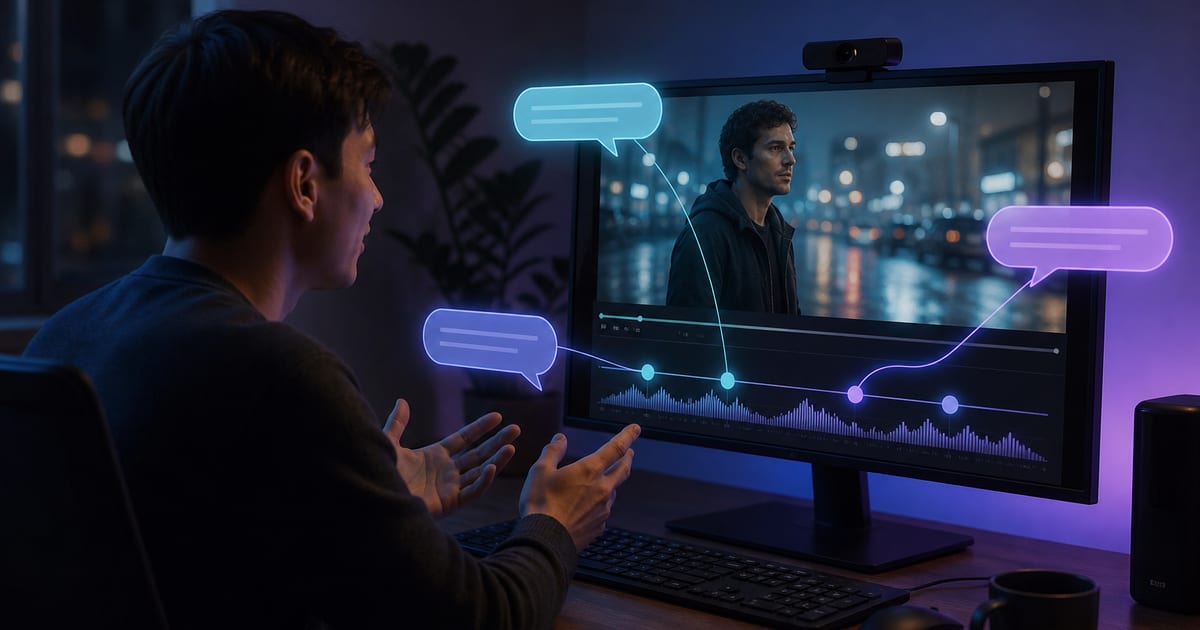
Without timestamps, AI chat gives you a claim. With timestamps, AI chat gives you an index. "Inflation hedge discussion starts at 32:14" is actionable. "They talked about inflation hedges somewhere" is not.
Citations also change your relationship to the model. Research on LLM text with citations frames verifiability as a first-class goal: answers should be checkable against retrieved passages, not merely fluent (ALCE benchmark paper). In a video product, the analogous "passage" is a moment on the timeline.
That unlocks real loops:
- Students ask "What limitation did the professor mention?" → click → 20-second verify → write notes.
- Researchers extract a quote with provenance instead of scrubbing a two-hour interview.
- Creators reverse-engineer a competitor intro by jumping to the exact hook, not a paraphrased guess.
- Professionals build a meeting brief from a webinar without rewatching the whole thing.
Summario's chat is designed for that verify-in-one-click pattern. If you cannot jump to the evidence, you do not really have grounded video chat — you have a summary with a chat skin.
Practical Use Cases
Triage before you commit. Start with a Watch/Skip-style verdict or a short structured summary, then use chat only on videos that clear the bar. Chat is expensive attention; do not spend it on filler.
Deep dive without full playback. For a 90-minute podcast, ask for the three arguments on topic X, then watch only those segments.
Active recall. Close the video, answer from memory, then ask the chat to quiz you and check yourself via timestamps. (Retrieval practice is one of the strongest learning techniques in the education literature — see Roediger & Karpicke, 2006.)
Meeting and webinar capture. After a recorded session, ask for decisions, owners, and open questions. Export or paste into your notes tool.
Competitive research. "How do they structure the first two minutes?" beats watching ten intros back-to-back.
If your job is multi-source literature synthesis across PDFs and videos, a research notebook product may fit better than a single-video extension — we compare that trade-off in NotebookLM vs YouTube summarizer tools.
Honest Limitations (Read These Before You Trust Any Tool)
Transcript-only is not watching. Most AI video chat reads speech-to-text. Silent demos, on-screen code, chart labels, and gesture-heavy teaching can disappear entirely. For spoken-word YouTube (podcasts, interviews, many lectures), this is usually fine. For design critiques or UI walkthroughs, it is not.
Caption quality caps answer quality. Auto-captions stumble on names, jargon, accents, and crosstalk. Grounding cannot invent a clean transcript from a bad one.
Disabled captions / restricted videos. If no transcript can be obtained, chat either fails or falls back to ungrounded topic knowledge. Prefer tools that admit failure.
Long context still degrades. Stuffing a two-hour transcript into a single prompt is a known failure mode. Better systems chunk, retrieve, and cite. Worse systems get vague about the middle.
Citations can be wrong even when present. A timestamp that does not support the claim is worse than no timestamp because it creates false confidence. Always spot-check important answers.
Privacy and retention. Anything you chat about a video may be logged by the provider. Read the privacy policy if the content is sensitive.
These limits are why Summario leans on cited timestamps and Watch/Skip reasoning instead of promising "we understand every pixel." For the large share of informational YouTube that is primarily spoken, transcript-grounded chat is already transformative. For visual-first content, watch the relevant minutes yourself.
How to Evaluate Any "Chat With This Video" Product
Use this checklist before you trust a workflow:
- Does every non-trivial answer include a timestamp or quote you can open?
- Does the tool refuse questions the video does not answer?
- Can it handle a 60–120 minute source without collapsing into generic advice?
- Is the chat attached to a triage summary (so you do not chat with junk videos)?
- Can results leave the page (export, email, WhatsApp) if that is how you work?
- Is pricing clear on free vs paid — and is the free tier usable?
If a landing page only says "powered by GPT" and shows a chat bubble, assume ungrounded until proven otherwise.
Getting Started With Grounded YouTube Chat
A practical starter workflow:
- Pick a public video you already know well (so you can spot errors).
- Run a quick summary / Watch/Skip pass.
- Ask two specific questions and one "gotcha" question the video does not cover.
- Click every citation. If jumps are wrong, the product is not ready for research use.
- Only then use it on unfamiliar videos.
With Summario, that loop lives in the Chrome extension and web app: summarize on the video page, chat with citations, and optionally subscribe channels to digests. Start on the free tier; upgrade to Pro (~$5.75/mo annual) if you need more full analyses and daily volume.
For the feature deep-dive, open YouTube AI chat. For tool shopping across the category, see best YouTube summarizers in 2026.
Grounded chat will not replace watching. It replaces blind watching — the hours spent hoping the important bit appears eventually. Used honestly, with citations and skepticism, it is one of the few AI features that earns its place in a weekly routine.
FAQ
What is grounded AI video chat?
Grounded AI video chat means the model answers from the actual transcript (or other retrieved video text), not from general training knowledge about the topic. Strong implementations also attach timestamp citations so you can verify each claim in the original video.
Can ChatGPT chat with a YouTube video if I paste the URL?
Pasting a YouTube URL into ChatGPT does not reliably make it watch or analyze that video. The dependable workaround is to paste the transcript yourself, or use a plugin/tool that fetches captions. Even then, you usually will not get clickable, verifiable timestamps unless the tool is built for that.
Why do timestamp citations matter in AI video chat?
Timestamps turn answers into an index. Instead of trusting a paraphrase, you click 14:22, hear the original line, and decide for yourself. That reduces hallucination risk and saves scrubbing through long videos.
Does AI video chat actually watch the video?
Most consumer tools do not. They read the transcript or captions. If something important appears only on screen — a chart, slide text, or silent demo — transcript-based chat will miss it unless the tool also uses visual analysis.
How is Ask YouTube different from chatting with one video?
Ask YouTube is YouTube's conversational search experience: it synthesizes answers across videos and the web, often with cited clips. Single-video chat tools focus on one URL — summarizing it, answering questions about it, and jumping to moments inside that video.
When should I use a dedicated YouTube AI chat tool?
Use a dedicated tool when you regularly need Watch/Skip triage, follow-up Q&A with citations, or digests across channels. Manual ChatGPT paste is fine for occasional one-offs; purpose-built chat wins when accuracy and speed matter every day.